Stance, Guard, and Balance
A usable stance supports movement in more than one direction. Guard position and balance help the trainee punch, defend, and recover without unnecessary resets.
Coach profile
Jesse Rodriguez leads boxing instruction at RingCenTraining, helping trainees understand and practice the technical details that connect effective stance, punching, movement, and defense.
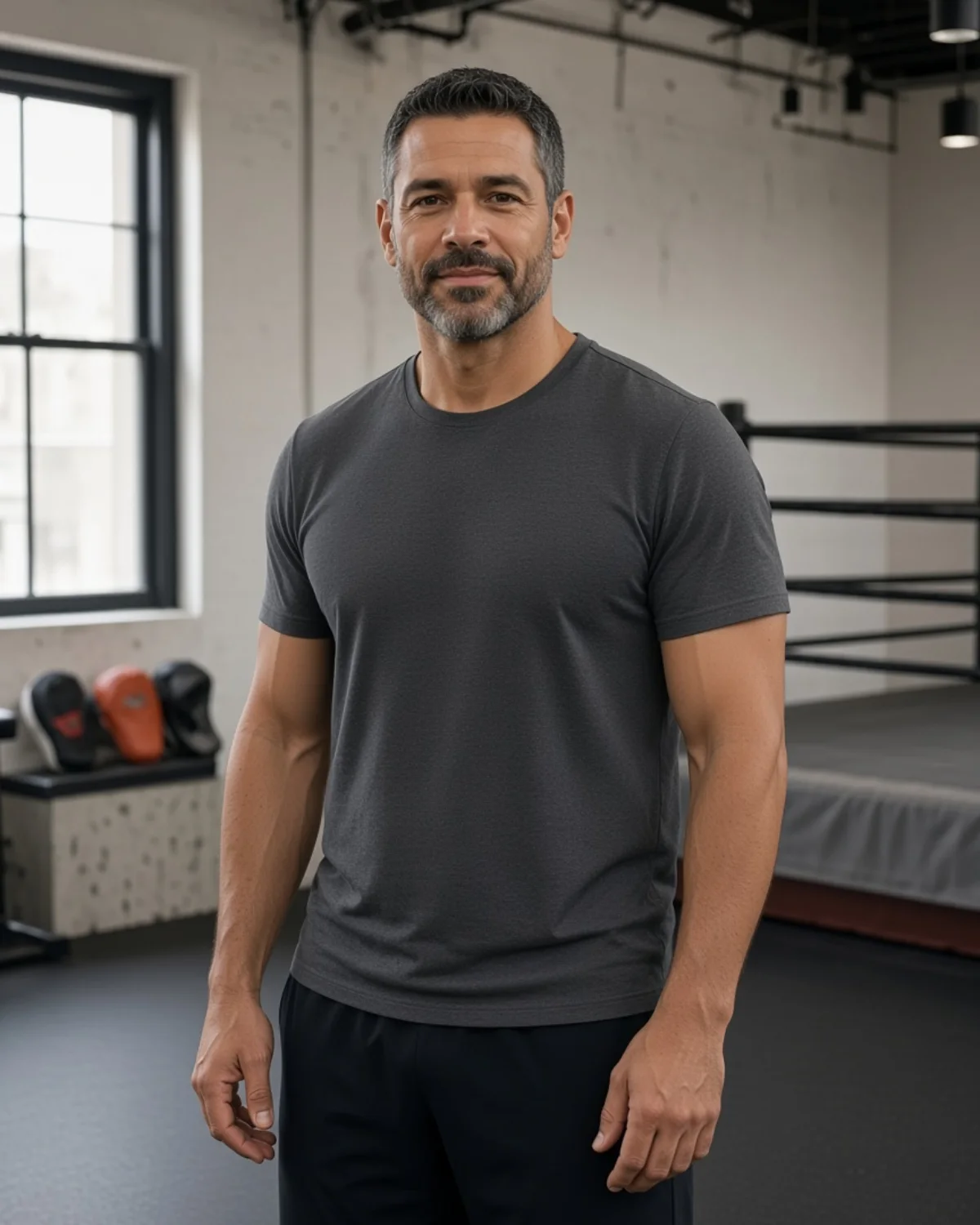
Coach at RingCenTraining
Jesse is the coach leading boxing training at RingCenTraining in Brooklyn.
He brings a strong practical boxing background and a substantial understanding of boxing fundamentals and training. His coaching centers on helping people recognize what a movement should accomplish, then giving them enough well-directed practice to make useful adjustments.
This profile describes how Jesse teaches. It does not claim a professional or amateur fight record, championship history, certification, affiliation, or other résumé detail that has not been established.
Learn about RingCenTrainingTechnical priorities
Jesse treats fundamentals as working parts of boxing rather than a checklist trainees leave behind. Each detail affects the next action and the position a boxer has after that action is complete.
A usable stance supports movement in more than one direction. Guard position and balance help the trainee punch, defend, and recover without unnecessary resets.
Jesse can break a punch into alignment, rotation, weight transfer, target, and return. The hand returning to guard matters as much as the hand reaching the target.
Stepping, pivots, angles, and range are practiced in relation to the punches or defensive actions they are meant to support.
Distance, guard, blocks, slips, rolls, and exits can be introduced in controlled sequences before being connected to combinations.
Punches are linked without sacrificing balance. A combination can include an entry, a defensive action, or an exit rather than ending at the final punch.
Development comes from adding complexity when the underlying movement is understood—not simply asking for more speed or power.
A session may begin with Jesse observing how a trainee stands, moves, and performs a basic action. Observation gives the instruction a practical starting point: a foot may be too narrow, a shoulder may turn too early, or the trainee may finish a punch without a stable position.
Jesse can then explain the issue, demonstrate the movement, and give the trainee a controlled way to practice it. Corrections are applied during the next repetition rather than saved as abstract advice. Repetition continues long enough to see whether the adjustment is understandable and repeatable.
Once an individual skill is more organized, it can be combined with another action. A jab may be connected to a step, a cross to a balanced return, or a combination to defense and an exit. Appropriate bag, mitt, movement, or conditioning drills can test whether the trainee maintains the same technical priorities through a round.
The exact structure varies with the person's experience, the training format, and the purpose of that session. Not every session uses every tool, and increasing difficulty is not the only sign of useful practice.
Previous boxing experience is not required to train with Jesse. A beginner can start by learning how to stand, hold a guard, move without crossing the feet, and throw basic punches with control.
Simple combinations and defensive ideas can be added as those pieces become more familiar. Bag work provides a consistent target, while mitt work can provide an immediate visual cue and a chance to pause for correction. Conditioning may be included at an appropriate level without turning technical instruction into an intimidating test.
The beginner boxing page explains first-session expectations and equipment guidance.
A trainee who already understands the basic positions may spend more time on details that repeat across rounds: balance after a combination, distance on the jab, foot placement during an angle change, defensive movement after punching, or a habit that appears during pad work.
Jesse can narrow the session to one recurring issue, compare different repetitions, and use controlled drills to see whether a correction holds when movement or pace is added. This is technical development, not a claim that RingCenTraining operates as a professional-fight or competition gym.
Related work is described on the boxing technique training page.
Different coaching settings
Jesse applies the same attention to sound boxing positions in different ways depending on whether he is coaching one trainee or organizing a group.
Individual sessions create more time for observation, specific corrections, questions, and repeated attempts at the same movement. Jesse can work from the trainee's current level and keep the session centered on a technical priority instead of following a class-wide clock.
Review one-on-one boxing coaching for the ongoing coaching process or private boxing training for session formats and current prices.
In a group session, Jesse demonstrates the drill, organizes rounds, keeps the class focused on the day's technical theme, and provides individual corrections where practical. Participants may use different levels of complexity while working within the same structure.
Group sessions can progress through skill practice, bag or partner drills where appropriate, and conditioning while maintaining safe spacing and technical attention. See group boxing training for class details.
Understanding the whole movement
Jesse's approach gives equal attention to the positions that make punches useful. A clean-looking punch has limited value if the trainee cannot reach the target safely, defend the return, or remain balanced afterward.
Where the feet and body are placed determines which punches are available and whether the trainee is close enough—or too close—to use them.
Footwork should support the hands. Steps, pivots, and weight shifts are coordinated with offense and defense rather than treated as unrelated warm-up drills.
Bag, pad, and conditioning rounds can challenge concentration. The goal is to keep stance, guard, balance, and decision-making present as effort builds.
Movement, defense, distance, and balance give combinations a beginning and an end. Practicing those connections helps a trainee understand boxing as a complete sequence rather than a series of isolated punches.
To request training with Jesse, contact RingCenTraining with your experience level, preferred format, and requested date or time. The business reviews the request and contacts you about availability. Submitting a request does not automatically confirm a session.
Payment is made in person at the training location. Individual sessions and classes remain subject to the published schedule and confirmation.
Train with Jesse
Tell RingCenTraining what you want to work on and which times you prefer. Your session exists only after availability is confirmed.