Boxing Training for Complete Beginners
Beginner training is for people who have never boxed, participants returning after a long break, and fitness clients who want to learn the sport correctly instead of simply throwing punches for exercise. You do not need to arrive with a developed stance, strong conditioning, or knowledge of boxing terminology.
The early goal is control. You learn where to place your feet, how to hold your guard, how to move without crossing your legs, and how to return your hands to a safe position after each punch. The pace can be adjusted while you become comfortable with the movements.
What a First Boxing Session May Involve
A first session typically begins with a short conversation about your experience and what you want from training. Instruction can then move through stance, guard, basic movement, and one or two punches before combining those pieces in a simple drill. The exact sequence depends on what you can perform with balance and control.
You may use shadowboxing, pads, or a heavy bag when appropriate. Conditioning can be included, but technique remains the priority. The listed first session is 60 minutes and is not confirmed until RingCenTraining responds to your request.
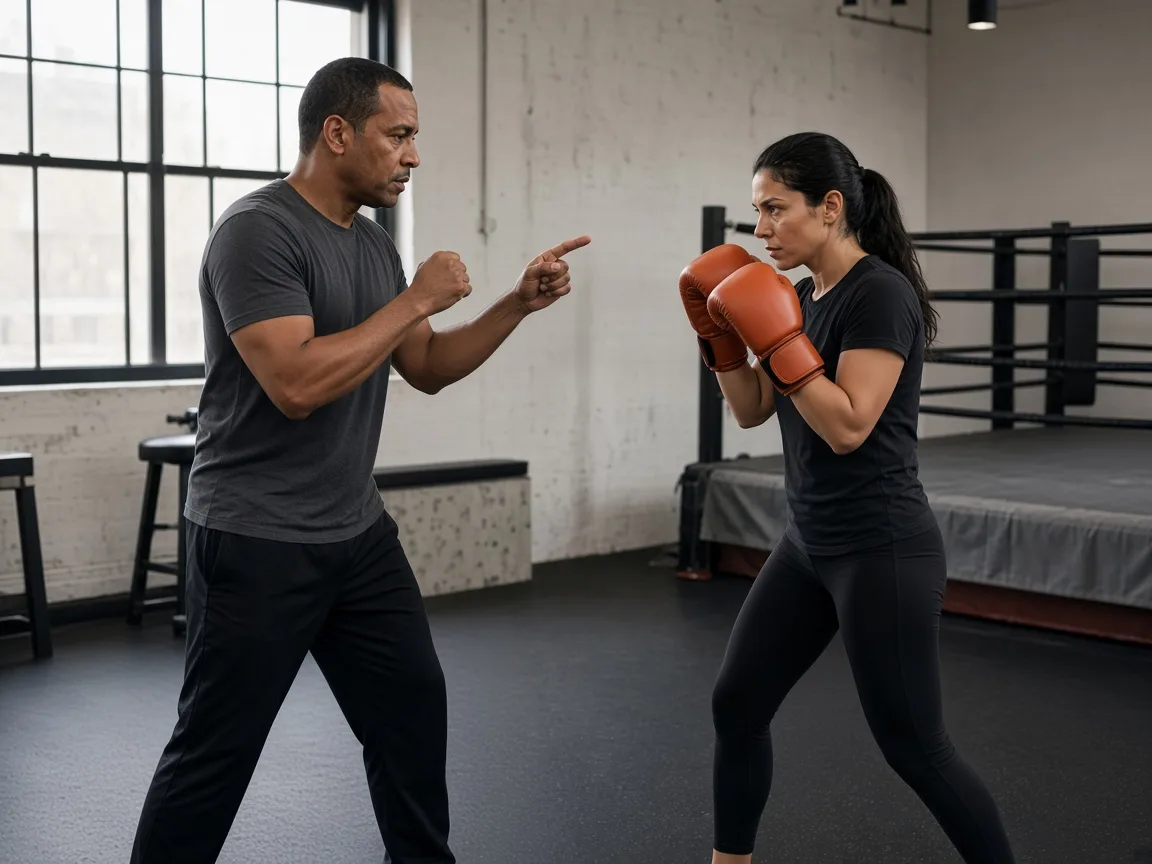
What You Learn in Beginner Boxing
Skills are introduced separately and then connected. Repetition matters, but each repetition should have a clear purpose: stable feet, a protected chin, a clean punch path, or a balanced return to stance.
Boxing Stance and Guard
Set your feet at a useful width, distribute your weight, protect your head and body, and learn where your hands return after punching.
Basic Punches
Practice the jab and cross before adding hooks or uppercuts. Attention stays on alignment, rotation, balance, and returning to guard.
Boxing Footwork
Step forward, backward, and laterally while maintaining stance. Later drills can add pivots and changes of direction.
Basic Defense
Learn distance, a dependable guard, simple blocks, and introductory slips or rolls without losing sight of your position.
Bag Work, Pad Work, and Conditioning
Bag work gives you a stable target for practicing range, punch placement, and combinations. Pad work adds a responsive target and allows immediate coaching between repetitions. Neither is just about hitting hard; beginners benefit most from controlled rounds with one or two technical goals.
Conditioning may use timed boxing rounds, movement drills, or simple bodyweight work. The workload can be adjusted to your current experience, and no fitness result is guaranteed.
What to Bring
Bring comfortable athletic clothing, clean athletic shoes suitable for indoor training, water, hand wraps, boxing gloves if you own them, and any equipment specifically requested when your session is confirmed. You do not need to purchase expensive equipment before a first session. Ask during booking whether gloves or other equipment are available to borrow.
Age and Participation Guidance
RingCenTraining may accept trainees from age 8 onward when the training format is appropriate for the participant. Availability and intensity depend on the session and coach assessment.
Ages 8–12
Youth and beginner instruction can cover stance, guard, movement, coordination, basic technique, controlled bag work, and controlled mitt work. A parent or legal guardian must complete or approve required registration, consent, and waiver documentation. Sparring is not advertised for this age group.
Ages 13–15
Age-appropriate training may include fundamentals, combinations, footwork, defense, bag work, mitt work, controlled drills, and conditioning. Parent or legal guardian consent and required waiver documentation are required.
Ages 16–17
Participants may take part in appropriate beginner, private, group, technique, and fitness training based on the session and coach assessment. Parent or legal guardian consent and required waiver documentation are required.
Ages 18 and Older
Adults may request available beginner, private, group, technique, or boxing-fitness training and complete their own required participation documentation. There is no arbitrary maximum age, but training intensity and format should match the participant's experience and physical capacity.
Not every program is appropriate for every individual. Participants should communicate relevant limitations before training.
Private or Group Training for Beginners?
Private boxing training provides more time for individual corrections and can be useful if you prefer a slower pace or want to focus on specific mechanics. Group boxing training follows a shared class structure and lets you practice alongside other participants. Beginners can use either format; the better choice depends on how much individual attention you want and which times are available.